From Chalk to ChatGPT: 10 Powerful Ways AI is Transforming Teacher Training in 2026
Introduction: The Evolution of Teaching
Education has undergone a remarkable transformation—from chalkboards and traditional teaching methods to AI-powered, interactive classrooms. In today’s fast-changing world, teacher training must evolve to prepare educators who can guide future-ready learners.
Artificial Intelligence (AI) is no longer a luxury in education—it is a necessity. Integrating AI tools into teacher training enables educators to become more efficient, creative, and impactful. Most importantly, it helps teachers shift from being mere knowledge providers to facilitators of meaningful learning experiences.
Why AI in Teacher Training Matters
- 📊 85% of teachers say AI reduces lesson preparation time
- 📊 40% increase in teacher productivity with AI tools
- 📊 60% improvement in student engagement in AI-supported classrooms
- 📊 By 2030, AI in education is expected to grow by 45% globally
- 📊 1 in 2 schools are already adopting AI in some form
👉 These numbers clearly show that AI in teacher training is essential for modern education.
Traditional Teaching vs AI-Integrated Teaching
Traditional Approach
- Teacher-centered learning
- Fixed lesson plans
- Manual assessment
- Limited student engagement
AI-Integrated Approach
- Student-centered learning
- Adaptive lesson planning
- Automated assessments
- High engagement through interactive content
👉 Result: Teachers save time and focus more on student development.

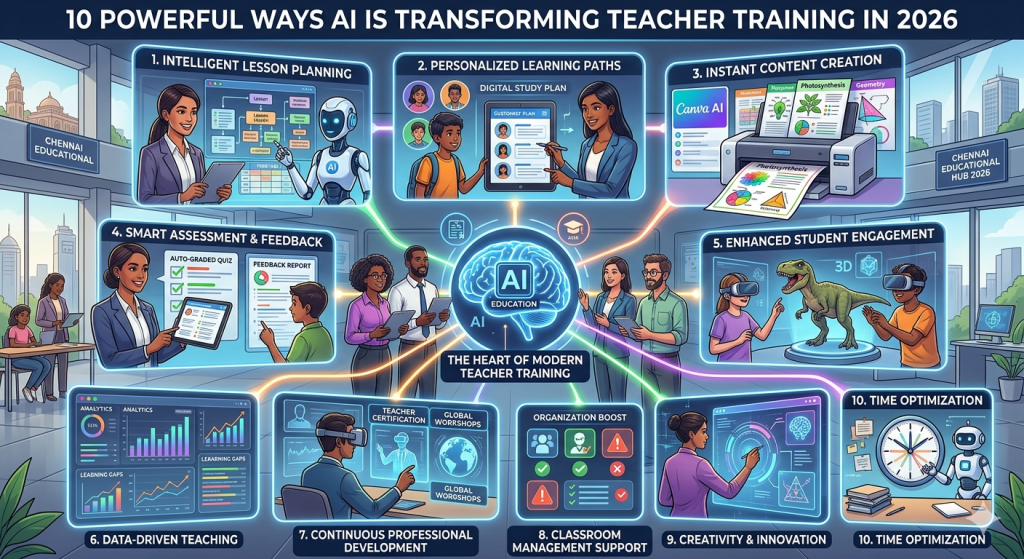
10 Powerful Ways AI is Transforming Teacher Training
1. Intelligent Lesson Planning
AI helps generate structured lesson plans instantly.
✔️ Saves up to 40% of preparation time
2. Personalized Learning
Teachers can tailor lessons based on student needs.
✔️ Ensures inclusive education
3. Instant Content Creation
Worksheets, notes, and presentations can be created quickly.
✔️ Improves efficiency
4. Smart Assessment & Feedback
Automated grading and analytics improve accuracy.
✔️ Saves time and effort
5. Enhanced Student Engagement
Gamified and interactive lessons increase interest.
✔️ Boosts participation
6. Data-Driven Teaching
AI analyzes student performance and learning gaps.
✔️ Improves teaching decisions
7. Continuous Professional Development
Teachers can upgrade skills anytime.
✔️ Encourages lifelong learning
8. Classroom Management Support
Attendance and behavior tracking become easier.
✔️ Improves organization
9. Creativity and Innovation
AI inspires new teaching strategies.
✔️ Makes learning enjoyable
10. Time Optimization
Automation reduces workload.
✔️ Allows focus on teaching
Step-by-Step Guide: How to Integrate AI in Teacher Training
Step 1: Build Awareness
Conduct sessions to introduce AI and its benefits.
👉 Reduces fear and builds confidence
Step 2: Assess Digital Readiness
Categorize teachers based on skill levels.
👉 Ensures targeted training
Step 3: Provide Foundational Training
Train teachers in basic AI tools and usage.
👉 Builds strong foundation
Step 4: Classroom Integration
Encourage real-time use of AI in teaching.
👉 Bridges theory and practice
Step 5: Encourage Collaboration
Promote peer learning and idea sharing.
👉 Builds innovation culture
Step 6: Monitor and Give Feedback
Track usage and provide improvement suggestions.
👉 Ensures effectiveness
Step 7: Advanced Training
Introduce data-driven and personalized teaching methods.
👉 Enhances expertise
Step 8: Continuous Development
Conduct regular training and updates.
👉 Keeps teachers future-ready
Useful AI Tools for Teacher Training
- ChatGPT – Lesson planning and content creation
- Canva AI – Presentations and visuals
- Quizizz AI – Assessments and quizzes
- MagicSchool AI – Teacher-specific tools
- Curipod – Interactive lessons
- Diffit – Content adaptation
- Eduaide AI – Teaching support
- Google Gemini – Research and summaries
- Grammarly – Writing support
- Tome AI – Presentations
👉 These tools act as digital teaching assistants
Challenges in AI Integration
1. Lack of Technical Confidence
✔️ Solution: Beginner-friendly training
2. Resistance to Change
✔️ Solution: Show real benefits and success stories
3. Overdependence on AI
✔️ Solution: Encourage creativity and customization
4. Data Privacy Concerns
✔️ Solution: Use secure platforms
5. Infrastructure Issues
✔️ Solution: Gradual implementation
6. Time Constraints
✔️ Solution: Short, practical training sessions
Why This Matters for Teacher Training
AI integration helps:
- Improve teaching quality
- Increase efficiency
- Enhance student engagement
- Support personalized learning
Result: Stronger and more effective educators
Sri Krish International School – A Model for Modern Teacher Training
At Sri Krish International School, teacher training reflects a future-focused approach. https://srikrishinternationalschool.com/ and https://srikrishteachertraininginstitute.com/
Key Practices
- Hands-on AI training sessions
- Real classroom implementation
- Continuous skill development
- Collaborative learning
Outcomes
Teachers become:
- Confident
- Creative
- Efficient
Students benefit through:
- Engaging lessons
- Better understanding
- Personalized learning
Result: Excellence in education
Conclusion
The shift from chalk to ChatGPT is a powerful transformation in education.
AI in teacher training:
- Saves time
- Improves teaching quality
- Encourages innovation
- Prepares future-ready learners
Final Thought:
Empowered teachers create empowered students—and AI makes it possible.